Silk Road Starlight leverages the “super hub” of the China-Belarus Industrial Park to accelerate its expansion in Eurasia’s high-tech and healthcare sectors.
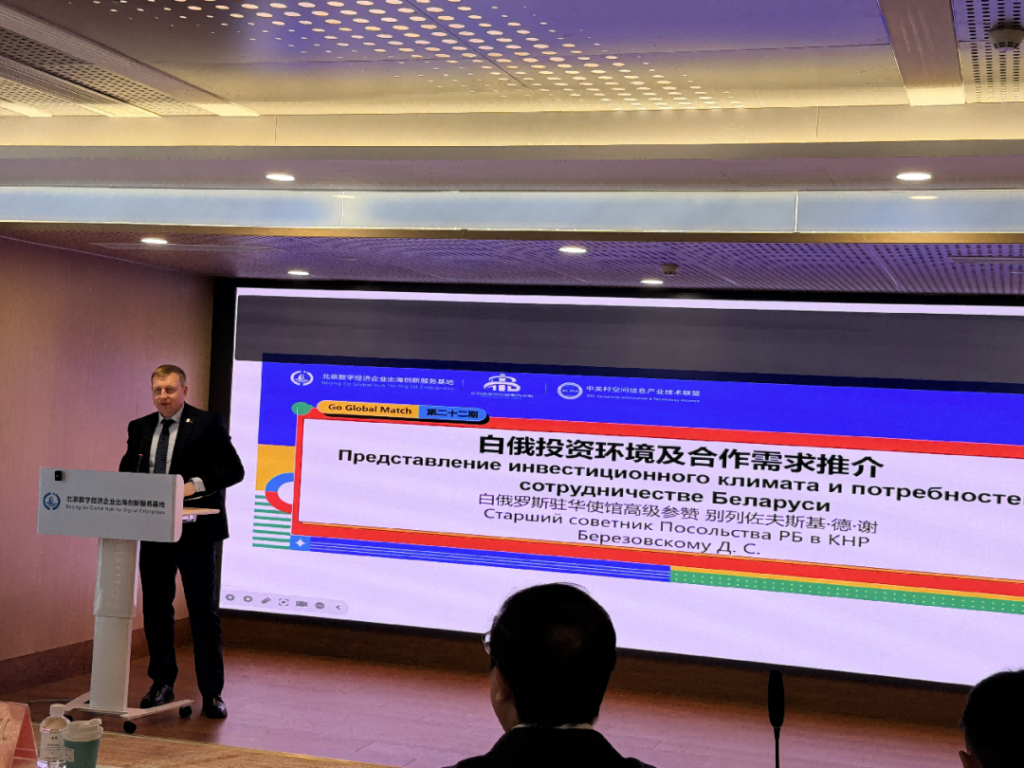
At a time when the Belt and Road Initiative is deeply integrated with the BRICS cooperation mechanism, the Silk Road Star team is leveraging its unique global perspective and top-tier domestic resources to accelerate its strategic layout in the hinterland of Eurasia. On May 7, the “China-Belarus Industrial Cooperation Matchmaking Event,” hosted by China-Belarus Industrial Park, was successfully held in Beijing. Mr.Chen, General Manager of Silk Road Star, was invited to attend the event and engaged in preliminary discussions with the Belarusian counselor and leaders of the China-Belarus Industrial Park (Great Stone Industrial Park). This matchmaking initiative aims to capitalize on the national-level policy advantages of the China-Belarus Industrial Park to expedite the company’s global expansion in smart manufacturing, healthcare, and cross-border trade.
I. National-Level Strategic Platform: The “Five-in-One” Advantages of the China-Belarus Industrial Park
As the overseas economic and trade cooperation zone with the largest planned area and the highest level of collaboration in which China has participated in investment and development, the China-Belarus Industrial Park is not only a landmark project of the “Silk Road Economic Belt” personally advocated by the heads of state of both countries, but also reached a milestone in its development in 2025.
According to the latest data, the total industrial output value of the China-Belarus Industrial Park reached $321.5 million in 2025, with corporate net profits growing by a remarkable 139% year-on-year, demonstrating strong growth momentum. The park has become the preferred destination for Chinese enterprises to “go global collectively” due to its four unique core advantages that are difficult to replicate:
Geographical Location and Market Reach: The park is situated in Minsk, the capital of Belarus, at a strategic transportation hub between Europe and Asia. As a key node for the China-Europe Railway Express, goods can be delivered directly to the park’s railway terminal. More importantly, as a member of the Eurasian Economic Union (EAEU), enterprises within the park enjoy preferential tariffs—either zero or reduced—to access vast markets such as Russia and Kazakhstan, which together comprise a population of 183 million, thereby effectively overcoming international trade barriers.
Excelling cost advantages: Compared to domestic markets, industrial parks possess significant competitiveness in terms of production factor costs. Data shows that natural gas prices in these parks are approximately 30% lower than those in China, electricity rates offer competitive advantages, and land acquisition and lease prices are highly attractive (with lease terms extending up to 99 years), significantly reducing operational costs for enterprises.
A solid industrial foundation: As of April 2026, the park has attracted 178 domestic enterprises from around the world, forming four major industrial clusters in mechanical manufacturing, electronics and communications, integrated logistics, and healthcare and pharmaceuticals. Notably, the establishment of sub-projects such as the Sinomach Torch Park has gathered over 20 technology innovation companies and institutions, including Haihong Medical and Dongfang Technology.
A rule-of-law-based business environment: The Belarusian government has enacted a Presidential Decree as the nation’s highest legislative instrument to safeguard industrial park policies. Currently, enterprises operating within the park enjoy ultra-long-term preferential policies spanning up to 50 years, covering tariffs, value-added tax, income tax, and other levies, with approximately 90% of business processes fully digitized—entreprise registration taking just 30 minutes.
II. Strategic Synergy of Silk Road Star: Mutual Empowerment of Capital and Trade
The Silk Road Star Team, leveraging a collaborative operational framework spanning Beijing, Guangzhou, and Chengdu with seamless domestic and international integration, keenly identified this as a historic opportunity—where its business scope aligns perfectly with the industrial positioning of the China-Belarus Industrial Park. At the conference, Mr.Chen, General Manager of Silk Road Star, delivered a prepared speech providing a comprehensive overview of the team.
There is a deep integration between high-tech and intelligent manufacturing. The “Primary Market Venture Capital Fund” established by Silk Road Star focuses on the fields of intelligent manufacturing, new energy, and new materials, aligning perfectly with the Zhongbai Industrial Park’s key development priorities in electronic communications, new materials, and scientific innovation research and development. The Silk Road Star team plans to leverage the park’s unique status as a Shanghai Cooperation Organization industrial park and a BRICS partner country to introduce China’s consumer electronics supply chain—including smart hardware and home appliances—into the area. By utilizing the local talent pool (Belarus boasts abundant STEM professionals at relatively low salaries) and affordable energy resources, the park aims to become a high-end manufacturing hub serving the Eurasian market.
Cross-border expansion in the healthcare sector. In the medical and pharmaceutical field, the Silk Road Star Team’s extensive expertise in medical devices, traditional Chinese medicine, medical aesthetics, and wellness healthcare aligns perfectly with the rapidly developing “biotechnology, pharmaceuticals, and medical services” sector within the China-Belarus Industrial Park. Leveraging the park’s “special policies for the medical and pharmaceutical sector,” the Silk Road Star Team is well-positioned to introduce China’s traditional Chinese medicine and high-end medical device products into the vast Russian-speaking regions and Central Asian markets in a compliant and efficient manner through Belarus as a key gateway.
Integration of trade and logistics networks. Leveraging its expertise in bulk trade, energy and mining sectors, and multimodal transport logistics, the Silk Road Star Team has capitalized on the logistical advantages of the China-Belarus Industrial Park as a key node for the China-Europe Railway Express to establish an efficient supply chain system centered on the Beijing-Guangzhou-Chengdu–Minsk corridor, achieving seamless integration across the entire value chain from raw material import to finished product export.
III. Looking ahead: Establishing a new benchmark for high-quality development of the Belt and Road Initiative
“Silk Road Star is not merely seeking a production base, but rather a strategic pivot capable of influencing the entire Eurasian continent,” emphasized Mr.Chen, CEO of Silk Road Star. “The China-Belarus Industrial Park offers more than just land and tax benefits—it provides an international platform that embodies political trust, economic integration, and cultural inclusivity.”
With the realization of various outcomes under the 2026 “China-Belarus Year of Scientific and Technological Innovation” and the deep involvement of globally-minded enterprises such as Silk Road Star, the China-Belarus Industrial Park is evolving from a mere industrial zone into a modern industrial city characterized by ecology, livability, prosperity, vitality, and innovation. This not only serves as a model of win-win cooperation between China and Belarus but also represents a vivid demonstration of how Chinese enterprises are leveraging the opportunities presented by the Belt and Road Initiative to achieve global expansion and engage in international capacity cooperation.